
The Hadzabe tribe in Tanzania lives in the Lake Eyasi region and is considered one of the last hunter-gatherer populations in East Africa. Visiting the Hadzabe means discovering a culture based on bow hunting, gathering wild plants and a distinctive click language. The experience is usually offered as a cultural safari in northern Tanzania.
Imagine leaving behind the safari vehicle, the well-trodden tracks and the comfortable lodges. Imagine setting off on foot along a red-earth path that winds its way through acacia and baobab trees, in the cool air of the early morning. Then, amongst the trees, the first figures appear. A group of men crouching round a dying fire, with bows as long as their bodies slung over their shoulders. Women moving through the vegetation, selecting roots and berries with the confidence of those who know every plant by name. Children watching the visitors with lively curiosity, without fear.
You are about to meet the Hadzabe, one of the last true traditional peoples of the African continent. A people whom National Geographic has described as among the closest living relatives of the humans who first left this continent to migrate to the rest of the world. There are fewer than 1,300 of them. They have no written language, do not practise agriculture, and recognise no form of political hierarchy. Their way of life has remained essentially unchanged for ten thousand years. And here you are, just a few steps away from them, to share a glimpse of their lives.
Hadzabe tribe in Tanzania: a traditional way of life on Lake Eyasi
Visiting the Hadzabe is not a tourist excursion in the conventional sense of the term. It is an anthropological immersion in a living culture, an encounter with a people who represent one of humanity’s oldest genetic lineages and who continue to live exactly as their ancestors did ten thousand years ago. This is not about observing a re-enactment or watching a folkloric performance: the experience takes place in the very places where the Hadzabe live their daily lives, as they go about the same activities they perform every day to survive.
This experience is aimed at all travellers who wish to go beyond the traditional safari in Tanzania and gain a first-hand insight into the human and cultural dimensions of this extraordinary country. Those who choose to visit the Hadzabe are driven by a curiosity about the deepest origins of our species, and by a desire to understand how a people have been able to resist change for millennia, whilst maintaining an harmony with nature that the modern world has completely lost.
Cultural safari to Lake Eyasi: meeting Africa’s last hunter-gatherers
There is a fundamental difference between reading about a people who live as they did ten thousand years ago and actually being there in their world. No documentary, no anthropology book can convey the effect of hearing the click language echo through the trees for the first time, of watching a hunter draw his bow in exactly the same posture as his ancestors, of seeing expert hands recognise a medicinal plant amongst hundreds of seemingly identical shrubs. An encounter with the Hadzabe is just that: a sensory and human experience that redefines our understanding of what it means to be human, before anything else that civilisation has added.
Who are the Hadzabe?
Understanding who the Hadzabe are and how their culture has been preserved is the first step towards fully appreciating the experience you are about to have. This is not about observing a historical re-enactment or watching a folk performance: the visit takes place in the very places where the Hadzabe live their daily lives, as they go about the same activities they perform every day to survive. Learning about their history, their language and their traditions transforms what is already an extraordinary encounter into an experience of deep understanding, one that leaves a lasting impression.
The last tribe of hunter-gatherers
The Hadzabe are the last remaining true hunter-gatherers of East Africa. They live in small nomadic groups of twenty to thirty people in the Lake Eyasi region, in the heart of the Tanzanian Rift Valley – a rugged landscape of dry savannah, acacia scrub and ancient baobab trees that has formed the ecological basis of their way of life since time immemorial. Genetic studies place their ancestral lineage amongst the oldest in humanity, with a divergence from other African populations dating back fifty thousand to seventy thousand years.
Their society is radically egalitarian. There are no leaders, hierarchies or power structures: decisions are taken by consensus, and every member of the group participates in community life with equal dignity. They do not practise agriculture, do not rear livestock, and do not build permanent settlements. Their dwellings are temporary huts made of branches and dry grass, which are abandoned and rebuilt elsewhere on average six times a year, depending on the availability of natural resources. In the oral history of the Hadzabe, there is no record of a famine: their profound knowledge of the environment and their nomadic way of life have guaranteed them a level of food security that many sedentary populations have never managed to achieve.
The click language and traditions
The Hadzabe speak Hadzane, a click language unique in the world, a linguistic isolate with no known relationship to any other language on the planet. The clicking sounds, produced by positioning the tongue against the palate in specific ways, each have their own semantic meaning and give this language an unmistakable musicality that deeply strikes those hearing it for the first time. Despite superficial similarities with the Khoisan languages of southern Africa, Hadzane belongs to a completely independent language family.
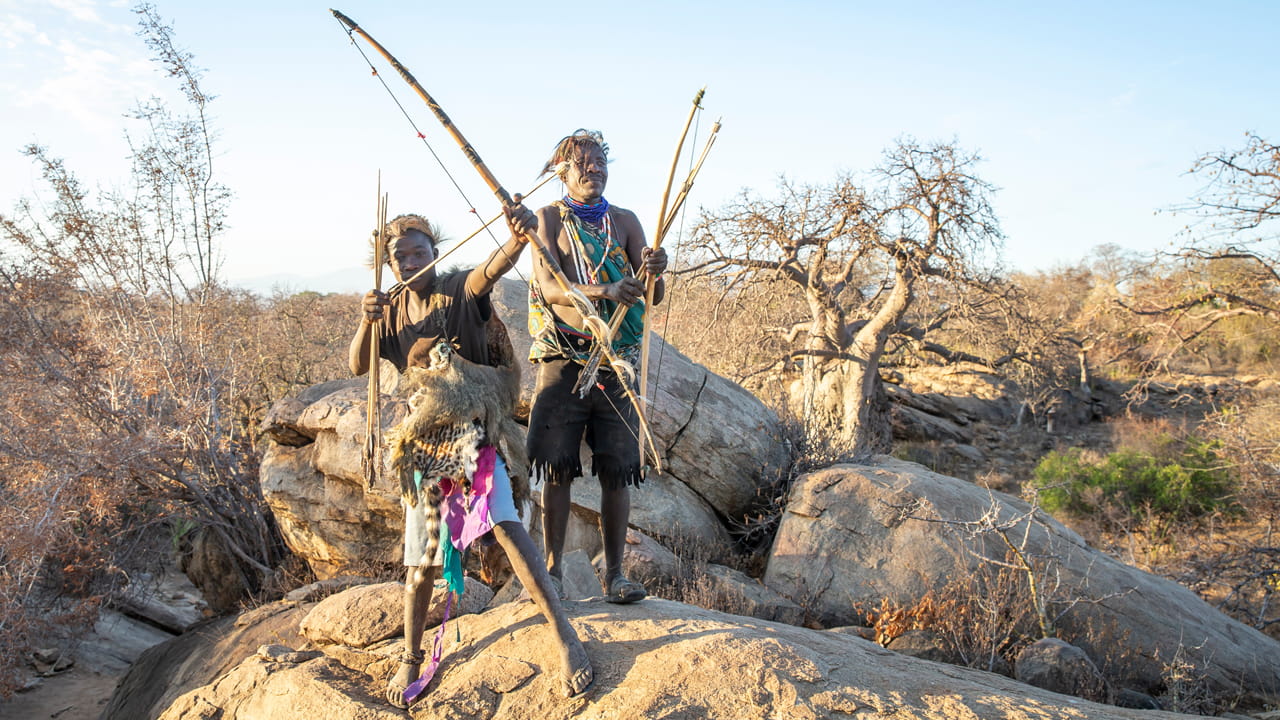
Daily life follows a division of roles that has been established over millennia. Women are the custodians of extraordinary botanical knowledge: they gather medicinal herbs, wild fruits, baobab berries and tubers, carefully selecting every useful plant from among hundreds of species. Men hunt with bows and arrows tipped with poison, weapons made entirely by hand from natural materials. The metal arrowheads are obtained through trade with the neighbouring Datoga tribe, the region’s traditional blacksmiths.
Those wishing to gain a deeper understanding of the culture of this fascinating people can combine the experience with a visit to the Datoga tribe, thereby completing a cultural picture of rare richness. Every resource obtained is shared amongst all members of the group, in an economy based on reciprocity and trust, which is perhaps the oldest and most enduring form of human social organisation.
What happens during a visit to the Hadzabe tribe?
The experience lasts around two hours and takes place in the early hours of the morning, when the Hadzabe begin their daily hunting and gathering activities. It is an experience that combines direct observation with active participation: visitors do not simply watch from a distance, but are welcomed into the rhythm of the group’s life, accompanied by a guide and a cultural mediator who translate, provide context for, and facilitate every moment of the encounter. Interaction with the tribe is direct and genuine, without any artificial barriers.
Early morning departure
The alarm goes off at dawn. The transfer to the area where the Hadzabe have set up camp takes place at first light, when the bushland around Lake Eyasi is still shrouded in the stillness of the morning. Advance booking is essential to ensure that the visit takes place in accordance with the community’s schedule and activities. Our arrival coincides with the moment when the group is getting ready for the day, and the atmosphere is immediately authentic: the fire being stoked, conversations in the click language echoing through the trees, and preparations for the hunt taking shape before the visitors’ eyes.
Hunting in the bush with the Hadzabe men
The most intense part of the experience is taking part in the morning hunt. The Hadzabe men move through the bush with an agility and an awareness of their surroundings that leave you speechless. Every trace on the ground tells a story that the hunters read as naturally as we read a book: footprints, broken branches and the movements of birds are all signs that guide the hunt with a precision honed over millennia of practice. The bows are powerful, the arrows lethal in their simplicity, and their marksmanship is the result of training that begins in early childhood.
Visitors can choose to take an active part, accompanying the hunters into the bush, or to observe from a more comfortable vantage point. Typical prey includes small mammals and birds, caught using techniques that demonstrate a profound ecological knowledge, passed down orally from generation to generation without ever having been set down in writing.
Harvesting with the Hadzabe women
Whilst the men hunt, the women devote themselves to foraging, an activity that forms the backbone of the Hadzabe diet. Following them across the savannah means discovering an ancient and sophisticated knowledge of botany: every shrub, every root, every wild fruit has a name, a use and a season. The women teach visitors how to recognise medicinal plants, how to dig up tubers from the ground using digging sticks, and how to gather baobab berries and wild fruits. It is a moment of intimate and relaxed sharing, where cultural barriers dissolve in the simplicity of the gestures and the generosity with which the Hadzabe women welcome those who show a genuine interest in their world.
Where does the visit to the Hadzabe people take place?
The visit to the Hadzabe takes place in the Lake Eyasi region, in northern Tanzania, a seasonal lake nestled between the walls of the Rift Valley and the highlands that separate this area from the vast plains of the Serengeti. It is a rugged and fascinating landscape, comprising arid savannah, rock formations and dense scrub, vastly different from the grassy expanses of the major wildlife parks but equally evocative in its unadorned beauty. Its proximity to Olduvai Gorge, one of the most important prehistoric sites on the planet, lends this area an anthropological significance that complements the experience of visiting the Hadzabe perfectly.
The area is easily accessible during a safari in the Northern Tanzania circuit, and a visit fits perfectly into itineraries that include Tanzania’s main national parks. Rather than as a stand-alone experience, it is recommended as a cultural stopover within a wider journey – an anthropological counterpoint to the naturalistic aspect of the safari that greatly enriches one’s understanding of this corner of Africa. An 8-day safari in Tanzania, for example, allows you to comfortably combine wildlife viewing with encounters with the region’s traditional communities.
Practical information and requirements
Organising a visit to the Hadzabe does not require any special preparations, but being aware of a few practical details helps you to enjoy the experience with the right sense of calm and awareness.
Who can take part
The experience is suitable for families, although it is not recommended for very young children: the bush setting, the walk and the duration of the activity are best suited to children who are able to participate actively and appreciate the cultural significance of the encounter. There are no specific age limits or restrictions on large groups. The experience is open to anyone with a genuine curiosity about traditional cultures and a desire for direct contact with one of the oldest peoples on the planet.
What to bring
No special equipment is required. Standard safari clothing is perfectly suitable, preferably in neutral colours and lightweight fabrics. Water and sun cream are recommended, as the activity takes place outdoors in the morning. Photography and filming are permitted, allowing you to freely document the experience and preserve visual memories of once-in-a-lifetime moments. There is no need to bring cash.
What’s included
The experience includes a tour guide, an interpreter and a cultural mediator who facilitates communication and provides context for every aspect of the visit, from history to traditions, from social organisation to the relationship with nature. The total duration is approximately two hours. The cost of the visit to the Hadzabe is treated as an extra activity in addition to the main safari package, and is always clearly and transparently communicated during the trip planning stage.
Why visit the Hadzabe with Tracks of Africa
Encountering one of the world’s last remaining bush hunter-gatherer communities requires sensitivity, expertise and a deep respect for the people and traditions involved. It is not an experience that can be improvised. Tracks of Africa, a safari tour operator in Tanzania with in-depth knowledge of the region and local communities, guarantees an authentic and respectful approach that celebrates Hadzabe culture without turning it into a spectacle.
The guides and cultural mediators selected by Tracks of Africa are professionals who have personal knowledge of the communities around Lake Eyasi and know how to facilitate a genuine encounter that leaves a lasting impression on those who experience it. Every visit is organised with full respect for the tribe’s schedule and customs, ensuring that the experience is as enriching for visitors as it is dignified for the Hadzabe.
This visit can be seamlessly incorporated into any itinerary in northern Tanzania, transforming it from a simple additional activity into a highlight of a journey that combines nature and culture, extraordinary landscapes and unforgettable encounters with local people. For Tanzania is not just the land of great national parks and the great migrations: it is also the land of a people who, through their way of life, preserve the deepest roots of our very humanity.
Are you ready to meet Africa’s last hunter-gatherers? Contact us to include a visit to the Hadzabe in your bespoke safari in Tanzania.